




Highsfield Forest Trail Concepts: From a Rough Idea to a Focused Video…
페이지 정보
작성자 Dusty 작성일26-10-27 15:17 조회1회 댓글0건관련링크
본문
Before writing a video prompt, decide what a viewer should notice first. That decision matters for outdoor storytellers and landscape artists researching Highsfield and Seedance 2.5. The example here uses forest trail concepts to plan an immersive environmental transition. A clear focal point makes the brief easier to write. It also makes review more concrete: a draft can be assessed against its purpose instead of being accepted simply because the lighting, background or movement looks impressive.

Highsfield’s public pages connect scene prompts, supported image inputs, model settings and review of completed results. Seedance 2.5 is the workflow discussed here, but current availability and accepted inputs should be checked in the generator. The public examples are references with their own context and model attribution. A gallery image is not a specification sheet; use it to study a creative decision rather than assume every visible technique is available in every model.
Give the Brief a Visible Purpose
Consider a fictional assignment for outdoor storytellers and landscape artists. Its purpose is to plan an immersive environmental transition. The setting is a shaded forest path with a stable central opening, and the required visual detail is the central path and consistent tree trunks. Start by choosing a single action the viewer can follow. A landscape concept is useful for choosing mood and camera direction. It should not be presented as a navigational guide or a current representation of trail conditions, which require verified local information.
Limit the brief to a subject, a setting and a visible event before deciding on style. Here, a shaded forest path with a stable central opening establishes the environment and http://?utm_source=ins263 leaves move gently while the path stays fixed supplies the event. The requirement is that the central path and consistent tree trunks stays recognizable. That combination gives the scene a practical structure. Additional direction should explain lighting or framing, without changing the assignment into several different scenes competing for a small amount of screen time.
Translate the Idea Into a Seedance 2.5 Prompt
A proposed scene prompt could read: "Setting: a shaded forest path with a stable central opening. Action: Leaves move gently while the path stays fixed. Camera: a slow forward move along the path. Preserve the central path and consistent tree trunks. Keep the background stable and end with the subject still recognizable." This is an original planning example, not a tested generation record. Select only input and output options the current model actually supports.
Separate subject motion from camera motion in the brief. In this scene, leaves move gently while the path stays fixed, while the view uses a slow forward move along the path. Those instructions should not quietly become two unrelated actions. State what stays fixed as clearly as what moves. The distinction is particularly useful when a reference image already establishes the object’s appearance but says nothing about how the shot should progress or where it should end.
The prompt should not repeat the same idea through several synonyms. If the subject is already described clearly, use the next sentence for movement or spatial relationships. Redundant wording makes a brief longer without making it clearer. For this exercise, state what should not change in the central path and consistent tree trunks, and reserve any later caption area deliberately. Exact promotional copy can be added after the visual result has been selected.
Study Published Images and Video Examples
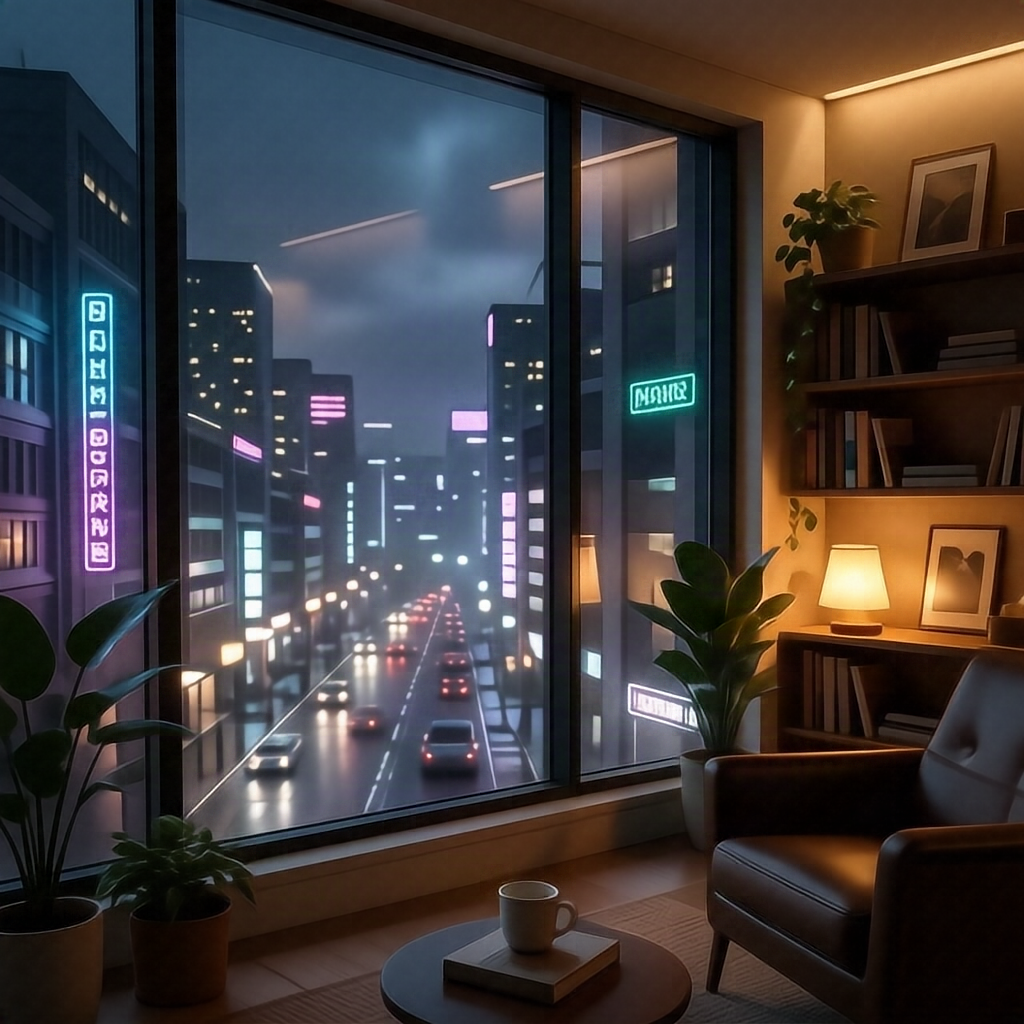 Published Highsfield visual reference: Reading room overlooking a neon city at night.
The published image shows a warmly lit reading room beside a cool city view. It is useful for studying the contrast between a stable interior and an atmospheric exterior. A still establishes appearance, while movement needs its own brief. Use that distinction when planning the proposed scene. This is a reference from the public site, not a newly generated result or proof of Seedance 2.5 performance.
Published city-street video example from Highsfield. Open the published video example.
The video poster shows a person seen from behind on a city street. Open the clip to study subject placement, travel direction and the role of background perspective, then judge the moving result rather than inferring it from the poster. Its use here is as a visual reference; this article does not attribute the clip to Seedance 2.5. Inspect the full action before applying a similar framing decision. The proposed project remains a separate, hypothetical exercise.
Check the Clip Against the Actual Assignment
For this particular concept, check the route through the frame and the stability of landmarks. Reject the draft if the path folds or tree trunks merge. That is a visible requirement rather than a general preference for a polished look. If the mismatch appears in only part of the clip, identify that moment before changing the brief. An acceptable opening frame does not excuse a subject or environment that becomes inaccurate during the intended action.
Ask another person to describe the clip without reading the prompt first. If their explanation differs from the intended purpose, the scene may be visually attractive but poorly communicated. An independent description can expose an unclear action. After that first impression, show the brief and inspect the mismatch together. For forest trail concepts, pay particular attention to the central path and consistent tree trunks and whether the camera gives that detail enough time to register.
A prompt review should ask whether the intended event is physically understandable and visually bounded. A viewer should know where the action begins and when it finishes. Clear boundaries help the reviewer judge completion. For forest trail concepts, the required detail should remain recognizable at both ends. If the scene ends with a different subject or an unrelated event, rewrite the assignment before pursuing extra effects or a more elaborate camera move.
Take the Highsfield Draft Into the Final Edit
A reference upload is a technical and editorial choice. Confirm that the current Highsfield model accepts the input type, and use material you are permitted to upload. A public image does not automatically grant reuse rights. Choose a reference because it explains the desired subject or composition. Keep a record of its origin so the final review can distinguish an approved source from a convenient but unsuitable image.
Download the selected result through the completed-job workflow available in Highsfield, then check the file in the editor you intend to use. Preserve its original prompt and the reference context. The saved file still needs a final production check. In this fictional assignment, place the approved scene brief beside the selected draft before editing the final caption. Verify that captions, crop and playback support the original purpose before the clip is placed beside promotional wording or shared as part of a larger story.
The practical standard is simple to state even when it takes several drafts to reach: the audience should see the intended action and recognize the required subject details. For forest trail concepts, the central path and consistent tree trunks is part of that standard. Highsfield’s Seedance 2.5 workflow can inform the brief, with current availability verified in the generator. Give each new attempt a specific reason. That habit makes the experiment easier to review, hand off and revisit when the project develops further.
댓글목록
등록된 댓글이 없습니다.